Call management in HVAC businesses: how many calls actually go unanswered?
Priovox Team
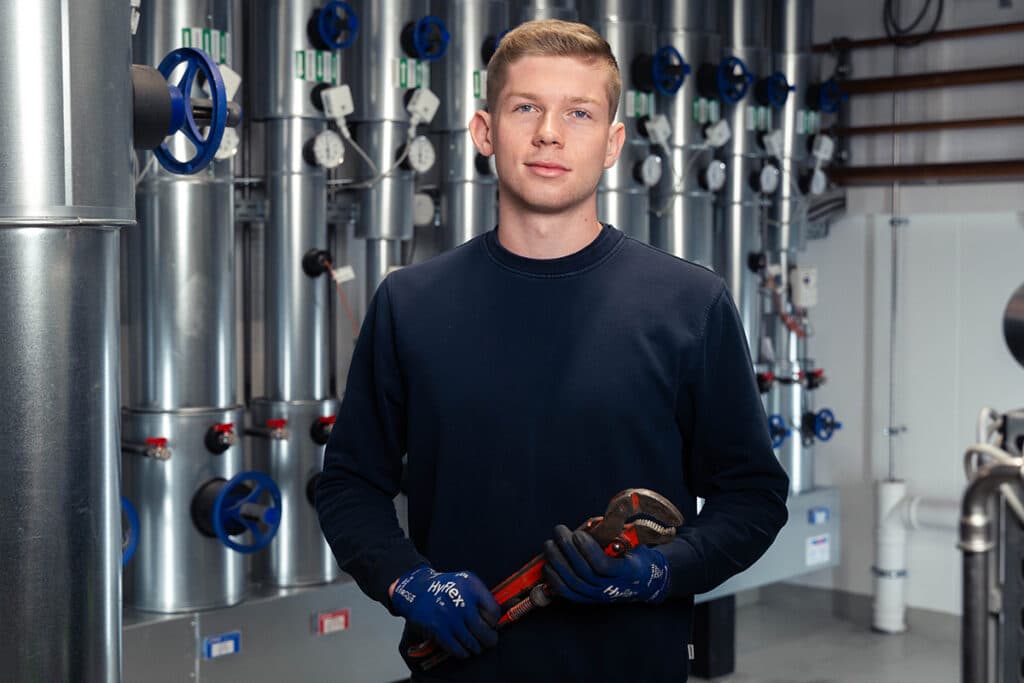
An HVAC technician is on site, both hands on a copper pipe. His phone buzzes in his chest pocket. He can’t answer. By the time he calls back two hours later, the caller has already contacted the next contractor in the Google results.
This happens in German HVAC businesses every day, hundreds of times over. This article collects the available numbers and calculates what missed calls actually cost the industry.
48,000 businesses, one shared problem
According to the ZVSHK (the German central association for plumbing, heating and air conditioning), there are roughly 48,050 HVAC businesses in Germany with a total of 388,334 employees (as of end 2024). The average business has about eight staff. Most of those are technicians out on jobs, not office workers answering phones.
The typical office setup in an eight-person HVAC company: one person, part-time, who simultaneously handles invoices, orders materials and takes phone calls. Or the owner, who answers between customer appointments.
How many calls go unanswered?
Exact figures for German HVAC businesses are not publicly available. What exists are surveys from the English-speaking world that frame the scale of the problem:
- An analysis by Invoca (2025) shows that home service businesses (plumbing, heating, electrical) miss around 27 percent of incoming calls.
- Broader studies for small businesses in general report up to 62 percent of calls going unanswered during business hours (RingEden, 2025).
- SkipCalls puts the annual cost of missed calls for contractors at an average of $50,000 or more.
These figures come from the US and UK. German HVAC businesses are smaller on average and have less office staff. It is plausible that the missed call rate here is at least as high.
The maths: what a missed call costs
Take a typical HVAC business:
| Metric | Value |
|---|---|
| Incoming calls per day | 8-12 |
| Missed (at 30%) | 3 |
| Share of potential new customers | 40% |
| New customers missed per day | 1-2 |
| Average first job value | 300-500 euros |
| Customer lifetime value | 2,000-5,000 euros |
A business that loses one potential new customer per day through a missed call, at an average first job value of 400 euros, loses around 8,000 euros per month in revenue. Over 250 working days per year, that is 100,000 euros in lost revenue from unanswered phone calls alone.
Not every missed caller would have become a paying customer. But even if only one in four would have resulted in a job, that is still 25,000 euros per year.
Why voicemail does not solve the problem
The obvious answer, voicemail, falls short. The numbers are clear: 80 percent of callers hang up when they reach voicemail (Forbes, 2024). In emergencies, such as a burst pipe, nobody calls and waits for a callback the next day.
Traditional answering services with human operators are an alternative but cost between 1.50 and 3 euros per call depending on the provider, and they cannot book appointments or look up customer data. At 10 calls per day, that is 400-600 euros per month, without the caller being able to do more than leave a message.
What is changing in the industry
The HVAC sector is not known for rapid digitalisation. But the pressure is growing. The ZVSHK reports a slight revenue decline for 2024, employee numbers are falling, and the number of new apprenticeship contracts dropped from 15,132 to 14,655. Fewer staff means even less capacity to answer calls.
At the same time, customer behaviour is shifting. Anyone looking for a tradesperson today expects a response within minutes, not hours. According to a ServiceTitan survey (2024), 78 percent of customers book with the first business that answers the phone.
Three developments are driving the topic right now:
Trade management software is becoming standard. Platforms like HERO, Fortytools, pds and KWP are present in a growing number of businesses. Anyone who manages their jobs digitally already has the infrastructure for intelligent call handling.
AI voice systems are production-ready. The quality of AI speech recognition and synthesis has taken a leap in the past two years. German conversations, dialects and technical terms like “condensing boiler” or “underfloor heating manifold” are recognised reliably.
Costs are falling. An AI phone assistant that is available around the clock, can book appointments and retrieve customer information from trade software costs less than half an office employee.
What businesses can do now
Before thinking about technology, a simple stock-take is worthwhile:
-
How many calls come in per day? Most phone systems and mobile providers show missed calls. Counting for one week is enough.
-
When do the calls come? Mornings between 8 and 10, at lunchtime, or after hours? If most calls arrive when nobody is in the office, a second office worker will not help either.
-
What do callers want? Appointment booking, price enquiry, emergency, callback request? Knowing this makes it possible to decide which calls can be handled automatically and which cannot.
The answers to these three questions reveal whether a business has an organisational problem (better planning helps), a staffing problem (an additional hire helps), or a reachability problem (technology helps).
Conclusion
The telephone remains the most important sales channel for HVAC businesses. But the industry has a structural problem: the people who generate revenue are on job sites, not at desks. Every missed call is a potential job that goes to a competitor.
The exact costs are hard to quantify because the industry barely collects its own data. But even conservative estimates arrive at five-figure sums per business per year. For an industry with 48,000 businesses, that is a topic that deserves attention.